Context

Historic context

Victoria has developed exponentially since European settlement. Originally timber huts housed a small but growing population. A legacy of the gold rush of the 1850s was an oversupply of underemployed miners. The extensive basalt plains of Victoria were a fertile ground for stonemasons who built the magnificent cities we see in Victoria today. These masons could not keep up with the demand as working basalt is a slow process. Brick makers then filled this gap and brick works popped up all over the colony as the population grew more affluent and wanted a better standard of housing.

This cultural and industrial heritage has largely been lost. The brick kilns are now gone. But the bricks remain. They are everywhere. Australia is now, as has been for a long time, the world’s largest per capita consumer of bricks. Nobody gives them a second thought. Many new arrivals in post-war Australia worked making bricks. Maybe one of your relatives was such a person. Almost nothing has been done in Victoria by the State Government to record this history, except a half-hearted attempt in the early 1980s by the Victoria State Archaeological Survey to record a few brick that came their way at a few sites. What ever became of them? Although some good came of it because a paper on “The Analysis of Bricks from Archaeological Sites in Australia; IAIN STUART” was produced. See it at http://www.jcis.net.au/data/23-04-Stuart.pdf


Even half the bricks we use today smash like China tea-pots if you drop them from any sort of height. Not like the old Victorian bricks. Oh no, they knew how to build houses in those days.

“Blue Collar”, P16, Danny King


What I want to do here is to show pictures of some of the bricks I have come across in my travels and give a short story about their maker. If you have anything to add, please let me know. PS: I do not collect bricks, only photographs of bricks. If you have some old bricks, let me know and I may come and photograph them and maybe find a story about them.

Saturday, April 5, 2014

Hammill, Avoca


When picking up old bricks around the place, context is everything.  Most are not stamped with a maker and where a hand made brick is found can be the only way to reasonably determine a maker.  Such is the case with this one.  I found it in a hotel car park in Avoca recently.  People don't value individual bricks as part of their heritage so they can be found just lying around, or dumped in skips.  The only person that I know of who was making this type of brick in this town was John Hammill.

John Hammill (1832 – 1899) arrived in Victoria in November 1852 with his family aboard the ship “Nuggett”; an appropriate name for potential gold diggers.  John however went into brick making, a profession he practiced with his son, also named John, for many years.  He was active from at least 1855 when he is remembered as doing the brick and stone-work for the Avoca Hotel where around 100,000 bricks were used.  From the look of buildings around town, he made both red and cream bricks. 


Chances are that they also made the bricks for the Post Office, Victoria Hotel, Albion Hotel (now closed), the former Hollands Drapery Shop, the former Bank of Victoria building, the Police Residence, the Uniting Church Complex, the Presbyterian Church Complex, the Powder Magazine, the Newsagency, the Pyrenees Cellar building, the former National Schools building and Lalor’s Pharmacy, as well as numerous homes and brick chimneys on timber homes.  Distinctive features of some of Hammil’s work appears to be the use of corbelled brickwork and dark headers.

Selkirk, Allendale


Today, Allendale (approximately 25 km north of Ballarat) is a far cry from its peak back in the days of the gold rush of the 1850’s.  Once a thriving service centre for the mining industry, the scattered remnants tell us little of the past. In fact, once Allendale was four adjoining towns in one; Allendale, Wallace Town, Ryans Town and Ristori Town, named after Adelaide Ristori (1822-1906) a famous Italian actress in her day.  She toured Australia in 1875.  Now the demarcation between the towns, and most of the towns themselves, are long gone.  Once a thriving settlement of over 1500 people, the town boasted a variety of facilities needed to maintain a thriving and profitable mining industry.  Allendale is now greatly reduced, but back in the day, it was a centre for gold miners, having six hotels, a museum and their own fire brigade.  


Into this community came Robert Selkirk.  Born in Fife, Scotland in 1819, he migrated to Victoria in 1854 with his family, including Robert Selkirk II who was also born in Fife, in 1841. Robert Jnr worked as a stonemason for years before making bricks in 1883 by hand at Allendale, just outside Ballarat.  RS2 gave up stonemasonry for timber splitting and moved to Cherry-Tree Flat near Ross Creek.  Later, in 1883 on his return to Allendale, he took up brick laying, but saw the demand for bricks in the growing town.  He had discovered suitable clay deposits behind his house in Allendale and by 1892, he had given up bricklaying and was a full-time Brickmaker.  He and one other worker built a drying shed, a clamp and wooden moulds and began production.  Robert eventually owned three properties around Allendale, two used for brick making and one for his home in Elizabeth Street with the works nearby.  Eventually, he employed ten workers who also made roof tiles and drainage pipes.  


He first made bricks from clay in a field in Ristori Town.  This was dug from the banks of mullock heap left at the Ristori mine in the De Murza paddock.  The clamp could produce up to 6,000 bricks per week.  These bricks were too soft after firing so he moved extraction to a new location.  Even though he considered these bricks too soft, they have lasted over a century.  He then made bricks from clay behind his house in Elizabeth Street.  By 1892, Robert moved to new premises around the corner in Garfield Street Allendale and had mechanised production through two scotch kilns.  Known as “Selkirks Brick Tile and Pipe Works”,


By 1887, bricks were being sent by rail to several destinations.  The delivery waggon, still catered to the local market.  By 1900, mining in Allendale was in rapid decline but Robert still had enough money to purchase land in Howitt Street in Ballarat.  Robert had seen the clay on the hillside there during his delivery trips.  He purchased 10 acres of land known as “Heinz’s Paddock” and the business relocated there in March 1900.  Robert offered the old clay pit to the local Creswick Shire Council to use as a rubbish dump, but they declined because it was too close to the town.  It is still there today. 

He built a Hoffman kiln in Ballarat from the last of his bricks made at Allendale.  It took over 400,000 bricks to make it and it had a capacity of 6.000.000 bricks per year.  Distribution through the nearby railway enabled the company to grow.


Today, Selkirk’s make 50,000,000 bricks each year, as well as other clay products and I believe that only one Selkirk remains with the company.  But this story is about the brick works in Allendale.  Even though he made thousands of bricks there, today, only two buildings remain that were made from his original bricks.  An old bakery, next to the nursery was made from his later Allendale bricks, and a kitchen with a chimney at the back of a weatherboard house is the only building made from the first works.  His bricks are scattered everywhere though.  Little piles in people’s gardens, garden edging and the occasional driveway are all that’s left.  This one was given to me by Ben, a long time resident, who also gave me some of this information.


Wednesday, April 2, 2014

Junction Brick Company


Trading Name
Oakleigh Brick Company
also known as the "Oakleigh Brick and Tile Company"
and the “Junction Brick Company”
Years of Operation
1909 to 1921
Company Number
 C0000832T
Address
Ferntree Gully Road to the North, Dandenong Road to the South and Tanner Street to the East.
Council Lot No.

Coordinates
 -37.896937, 145.100598
Current Use
Public Open Space (Hurst Park)


Also advertised in the Sands and Macdougall Directory of 1911 and 1912 as the Junction Steam Brick Co. (J.Hendy) Real High Grade Steam Bricks. Oakleigh; and 1915 as the Junction Brick Co. Pty Ltd. Dandenong Rd. Oak.  They appear to have had two incarnations, one as a brick works and the second as a roofing tile maker.

This was another of the small, short-lived companies in Oakleigh.  They were located on that small triangle of land now serving as parkland (Hurst Park) on the corner of Dandenong and Fern Tree Gully Roads.  Even though they called themselves a company, there is no record of them registering as a company in Victoria.  A sole trader making bricks is not an easy life and there is no further mention of this brick works.    
  
This triangle of land was part of the original Oakleigh East sub-division.  On the 27th of March 1890 the land was purchased by Clara Eliza Collins.   Ida Segemeier inherited this block when Clara died on the 29th of January 1902.  Ida sold it almost immediately to Ellen Matilda Green on the 17th of June 1902.  She then sold it to Joseph Murray, 3rd of March 1906.  

This is where brick making enters the picture.  The block was sub-divided and sold to Frank Oliver Harford on the 15th of June 1909, and the other block to John Hendy on the 24th of November 1909.  Both men were builders.  John bought out Frank on the 24th of November 1909 and consolidated the blocks where they then began brick making.  This did not last long because the land was again sold, this time to Frederick Oscar Bornum. Peter Finlayson and John Lemmon on the 2nd of June 1910, shortly after Frank and John's partnership dissolved. 

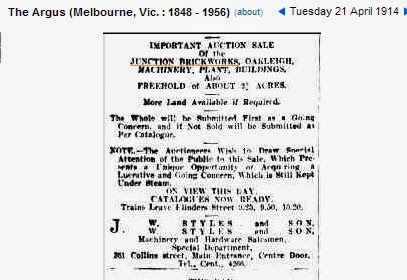
They couldn't make a go of it either and sold to Fritz Ernest Frankenberg on the 22nd of March 1912.  This is where the business went belly up with the plant and equipment being sold off., ownership was also short-lived and Fritz sold to Richard Arthur Ethell (another of Thomas's sons) the transfer happened on the 29th of October 1914.  The company is now listed in Sands and MacDougall under "Tile Makers."


Richard later sold to Harold Frank Hunt on the 23rd of December 1919.  (Harold dropped off the perch a couple of years after he sold off the works.) 


This next bit is where it could get confusing because Harold Hunt sold to the Terracotta Roofing Tile Company on the 24th of March 1921.  I suspect he saw a chance to offload what these days would be seen as an under performing asset but Harold was also a shareholder in the Terracotta Roofing Tile Company.  I think Harold probably did better out of the deal.  

For some time after the Junction Brickworks closed, their boiler was kept lit in the hope that the business would resume.  It was not still going in 1921.  This resumption of works did not happen and even when the Terracotta Company took over, sales never matched production   and the site eventually lay idle, becoming a dangerous eyesore and health hazard.  They owned the land until the 18th of August 1939 when it was acquired by Ernest Henry Montague Ratcliff (1863-1938).  Ernest was also a Director of the nearby Glen Iris Brick Company.


The property had lain idle since the closure of the Terra Cotta Roofing Tile Company (see separate post) The vacant site became a dumping ground and quickly became a health hazard.  Whatever plans Ernest may have had for the site, they never came to fruition and the Council took legal action against Ernest to clean up the site.

The partnership of J.Hendy, F.Harford and B.Rapley dissolved in 1910.  It is noted that the witness to this agreement was William Ethell. 


 According to the Oakleigh Council records, in July 1927, Council decided they needed a new site for a tip.  Cr Andrews moved that a hole on Dandenong Road be used, but Councilors threatened to resign if this was done.  In 1928 The East Oakleigh League wrote to the Council drawing attention to the unsightly condition of the defunct tile works on the corner of Dandenong and Fern Tree Gully Roads.  They suggested that Council purchase the property and make it into gardens.  The owners wanted £5,000.  Council said that they would pay only £2,500 for it – but no money was available.


 Junction Brick Works Site 1931
Aerial photograph courtesy of the Department of Environment and Primary Industries, Victoria

On the 17th of April 1929 the owners of the disused tile works at the corner of Dandenong and Fern Tree Gully Roads were given 14 days to erect a substantial fence around the clay hole.  I don’t think that this referred to the corner site.  If you look at the right of the picture, the remains of Scott’s pit can be seen encroaching onto Dandenong Road.  There is a reference to this company being started by the Moroney Brothers but there appears to be no evidence of this.  The carefully manicured parkland there now shows no sign of its former life.


Friday, February 21, 2014

Blackburn Brick and Tile Company Limited


The Blackburn Brick Co. was established off Whitehorse Road at 33 Alfred Street Blackburn.  The works were located  near the railway line.  They began around 1885 and at this time, their bricks were hand made.  Hand made bricks continued to be made until 1895.  They first appear in the Sands and MacDougall Directory in 1890, but were one of the brick works to close due to the impact of the depression of the 1890s.  They re-opened in 1892, possibly when it was renamed the Blackburn Brick & Tile Co and operated sporadically over the next year. They had an office at 422 Collins Street Melbourne.  According to Wise’s Commercial Directory, their Manager was Edward Perry.  Edward also managed the Bacchus Marsh Brick Tile and Pottery Co.  In 1893 the company contracted to supply 4,000,000 for construction of the Hobsons Bay main sewer.  The works closed again and lay idle until 1918 when they were bought out by the Co-operative brick Company.  The works were then used by them to make bricks and roofing tiles there, but converted to roofing tiles only in 1932.  In turn, in 1966, they became Brick and Pipe Industries Pty Ltd.  They closed the works in 1968. 


This plan of the site shows the outline at bottom right of what looks suspiciously like a Hoffman Kiln.  No details of the type of kiln used are available but it is reasonable to assume that a Hoffman kiln was used.

The Co-operative Brick Company Limited was formed by agreement between the Hoffman Patent Steam Brick Co., Northcote Brick Co. Ltd., New Northcote Brick Co. Ltd., Chas. Butler & Son and Fritsch, Holzer and Co., and registered on 10 September 1896. Authorized capital was 50,000 pounds in 50,000 shares of 1 pound. The word ‘proprietory’ was  added and registered on 11 February 1897. Authorized capital was  increased to £150,000 on 17 July 1927. During its 70 years of business, the Oakleigh Brick Co., Clifton Brick Co., City Brick Co., and the Standard Brick Co. (Box Hill) also became associated.

Brickworks Lane runs off Whitehorse Road Blackburn parallel to Alfred Street and shows the location of the old brickworks.


Tuesday, January 28, 2014

Clifton Brick


“Clifton Creams” were one of the best-known bricks in their day.  Look around at all those 60s cream brick veneer houses around Melbourne.  There is a better than even money chance that they were made by Clifton Bricks.  The business was started by David Clifton in 1890 from whom the company took its name.  It was not the best time for David to start a brick works because the land boom had ended and the depression of the 1890s bit hard.  Their works and quarry was in St. Georges Road Preston.   It was known as the “Northcote Brickworks.  David lived in one of the first three houses built in High Street Northcote.

His quarry was enormous, being some 50 meters deep in the end.  After it closed, like most others around Melbourne, it became a rubbish dump.  Now filled, it has become the Ray Bramham Gardens. 

They closed intermittently over the years, due to declining sales and the larger works selling off their own stocks below cost to keep going.  They finally closed their doors in 1898.   In 1907 the works were acquired by William Angliss and A.H.Angliss.  William Angliss had acquired interests in a wide range of business activities.  He was Chairman for many years of the Eagle Star Insurance Co. Ltd, Benbow Mills Pty Ltd, Clifton Brick and Tile Co  and Premier Printing Co., and Director of the Mutual Store, Davies Co-op & Co Ltd, Australian Cement Ltd, Hume Pipe Co. Ltd, Hume Steel Ltd and several other companies.  By 1950 he was reputed to be Australia’s richest man.


The new Manager (and part-owner) of Clifton Bricks was James Alexander Gamble who went on to start his own company.  The story goes that in 1915, James (b 29th August 1864, Fitzroy, Victoria, d 13th May 1926) was driving his Buick car along Heads Gully Road (because the Head family lived in the hollow near what later became the brick works) traveling towards Fern Tree Gully when he saw an outcrop of exposed shale near a bridge across the old frog hollow that had caused the widening of the road in 1860.  James took a sample back to Clifton Bricks and had it fired.  It produced a good quality red brick.

James sold his shares in Clifton Bricks and used the £9,500 along with a loan from the ES&A Bank to build his brickworks on former market garden land owned by Mr Hunt. James then started “The New Gamble Brick and Quarrying Company, but that is another story.

It took a while, but things slowly improved for Cliftons’ after the First World War.  The company had earlier become a member of the Co-operative Brick Company.  This group was formed by agreement between the Hoffman Patent Steam Brick Co., Northcote Brick Co. Ltd., New Northcote Brick Co. Ltd., Chas. Butler & Son and Fritsch, Holzer and Co., and registered on 10 September 1896. Authorized capital was 50,000 pounds in 50,000 shares of 1 pound. The word ‘proprietory’ was added and registered on 11 February 1897. Authorized capital was increased to £150,000 on 17 July 1927. During its 70 years of business the Oakleigh Brick Co., Clifton Brick Co., Blackburn Brick Co., City Brick Co., and the Standard Brick Co. (Box Hill) became associated.


Frog Mould for Hand Made Bricks

The year 1947 was a bad year for Clifton Bricks.  In October, a fire destroyed much of the works, the debris falling into the pit.  Over £30,000 damage was caused to their six storey brick works.  Also, as the suburbs developed, residents complained about the vibrations caused by explosives at the quarry.  In August, 1947 Clifton Brick and Tile Company carried out vibration tests on their brick pit at Preston. Tests were carried out at the brick pit on December 17th, 1947 and February 2nd, 1948. Six charges of explosives were detonated at different points in the brick pit and the amplitude of the ground movement was recorded. Additional records were made of ground movement due to other causes, such as vehicular traffic on a public roadway adjacent to the brick pit.  Tests were satisfactory as the quarrying continued.  In 1951 a storm swept across the State, causing the pit to flood, covering several trucks.

In 1952 Clifton Bricks took over Hoffman brickworks, and in 1965 acquired a controlling interest in the Oakleigh Brick Company Pty Ltd although the individual brick stamps continued to be used on their bricks.  In the 1960s, Clifton Brick took over the Brunswick brick works, they downsized operations and sold off assets. By the 1990s, the complex was still in operation by Nubrik, but by 2005 the site had been abandoned and had been developed as residential housing. The complex remains the only extant example of the clay industry that was central to Brunswick's development.

They closed the works and sold the assets.  The company was taken over by Brick and Pipe Industries Pty. Ltd., William Street, Melbourne, in 1966.  Subsequent mergers saw Clifton and Nubrick form the Austral Brick Company.  The company was de-listed from the Australian Stock Exchange on the 6th of March 1988.  A piece of the property was provided to the Brunswick Sheltered Workshop in 1968/  In 1968, Clifton Brick sold a further piece of land to them.  Brick & Pipe Industries was bought out by Pioneer Industries  in 1994 who were then bought out by Bristile in 2000.  Bristile then reverted to the Nubrik name.

Clifton Brick Holdings Pty Ltd (83 004 49 181), Cliyton Brick Manufacturers Pty Ltd (63 004 539 104) are controlled entities of Brickworks ( 82 999 602 531)


Thursday, January 16, 2014

Baxter & McKell


Abraham Baxter (Snr) and John Mc Kell acquired the brick works in Stamford Road Oakleigh in 1908 from Henry Ethell.  John McKell had previously been the Manager of the South Yarra Brickworks, formerly the Excelsior brickworks  in Chapel Street.  It appears that there had been an earlier family involvement, from Abraham (Snr) from around 1903.  At the time, three rectangular downdraught kilns operated there with capacities to accommodate from 40,000 to 60,000 bricks each.  Henry  Ethell did not enjoy a long retirement after the sale because he died at his home in Clyde Street Oakleigh the following year. 

The land began as a site for brick making on the 27th of April 1885 when Howard Tapley Clarton transferred ownership to John and Henry Goding.  Howard Tapley Clarton (1836 to 1902) was a man with either a casual acquaintance with the truth, or personal financial management ability.  Howard features prominently in the courts over an extended period.  As a Land Agent, he once applied to be allowed to pay one farthing in the pound on a 38,000 debt.  This was rejected.  Originally named Clarton Street, it was later renamed Stamford Road.  Was this as a result of Howard’s colourful business dealings?

The property was sold to Edwin Wade on the 8th of December 1887 who only owned the land until the 28th of May 1898 when it was again sold; this time to Henry Ethell. He lasted considerably longer when he sold to Abraham Baxter and John Mc Kell on the 21st of January 1908.  They held the land and sold to their company, the Oakleigh Brick works on the 23rd of July 1921.


On the 3rd of February 1910, the local paper carried an article saying that “Owing to the want of coal, the Oakleigh brickworks, employing about 60 men, have been closed down for the present.   The works have been carried on with a reduced staff for the past five weeks.”

A revamped company began operating in 1917.  Mr H.F. Young of the Northcote Brick Company was appointed as the Managing Director.  Again in 1928, another restructure took place and a new group of shareholders took over the company.  

Abraham Felix Baxter was born in Prahran, Melbourne on the 22nd of July 1880 to Abraham and Harriett (nee Booth).  He went to Wesley College in Melbourne and began his career with his father in the family firm of Baxter and Saddler.  Between 1901 and 1906, Abraham worked as a Railway Contractor with his brother George in Western Australia before returning to Victoria to join his brother Charles breeding horses near Ballarat.  Abraham Snr bought out Henry Ethell outright in 1908 and Abraham Jnr joined him there in 1910.  His father later made him their Manager.  (George supplied one and a half million railway sleepers to South Africa in 1901.)

On the 17th of March, 1918, Abraham married Margaret Mary Chapman (1883 to 1968).  They had two sons, James Abraham b 1909, Robert Walker b 1914 and one daughter Thelma Jean b 1919.

The year 1918, continued to be a busy one for Abraham; the Oakleigh Brick Company was sold to the Co-operative Brick Company and Abraham (Jnr) stayed on as Manager.  John McKell also continued to manage the South Yarra Brick Company.    The Oakleigh Brick Company followed others on the same site.  Previously there were the Excelsior Brick Works and the Eureka Brick Works.

Abraham died at his home in Clyde Street Oakleigh on the 22nd of October 1945.

Saturday, January 4, 2014

Historic Brick Collection


There are a couple of groups on the web chasing information about this document.  Since I subscribe to Groucho Marx' principle of not wanting to join any club that would have me as a member, I will give the details of where you can get this paper if you contact me with your contact details.